Views: 0 Author: Site Editor Publish Time: 2026-09-28 Origin: Site


Selecting the primary melting unit dictates the metallurgical capabilities, operational overhead, safety protocols, and long-term profitability of a steelmaking or foundry operation. Plant managers and metallurgical engineers face a complex trade-off between scrap flexibility, production scale, and capital expenditure when evaluating melting technologies. A misaligned choice results in excessive operational expenses, metallurgical bottlenecks, catastrophic safety risks, or failure to meet environmental compliance. You need to know exactly how your feedstock behaves under an electric arc versus an alternating magnetic field. This guide provides a rigorous, evidence-based comparison of EAF and induction melting technologies. We evaluate metallurgical constraints, economic realities, maintenance profiles, and implementation risks to support facility planning and procurement decisions. We will break down the mechanical differences, slag control limitations, refractory lifecycles, and grid impact factors to ensure your next facility upgrade aligns with your production targets.
Metallurgical Refining: EAFs allow for active metallurgical refining (desulfurization and dephosphorization) via slag control, whereas induction furnaces function strictly as melting units, requiring high-purity scrap.
Scrap Tolerance: EAFs can process lower-grade, bulky, and contaminated scrap. Induction furnaces require clean, sized, and known-composition charge materials to prevent bridging and safety hazards.
Cost Structures: Induction furnaces require significantly lower initial CAPEX and have a smaller facility footprint, while EAFs offer lower OPEX at high-tonnage scales despite higher initial infrastructure costs.
Alloy Precision: Induction furnaces provide superior temperature control and zero carbon pickup from electrodes, making them optimal for high-alloy and stainless steel production.
Maintenance & Downtime: EAFs rely on continuous, hot-patching refractory maintenance, while induction furnaces require complete, cold-crucible relining, often necessitating dual-body setups for continuous operation.
Table of Contents
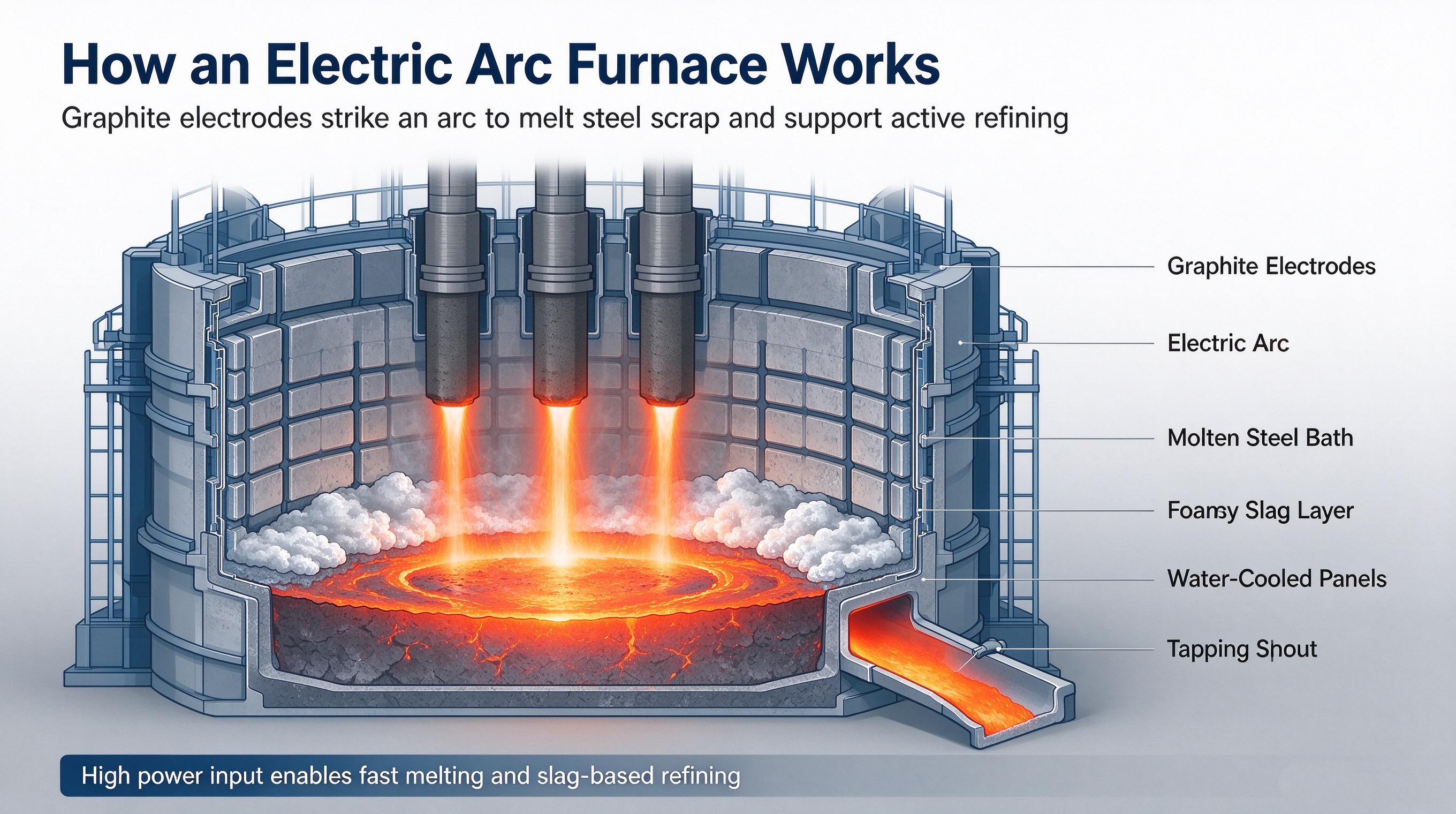
EAFs melt steel scrap by creating powerful electric arcs between graphite electrodes and solid metal, producing extreme heat to melt feedstock. AC EAFs use three roof-mounted electrodes, while DC versions use one top electrode plus a bottom anode. Modern EAFs combine electric power with chemical energy from oxygen, carbon and natural gas burners to speed melting, create foamy slag and cut electricity use, with large transformers ranging from 50 MVA to above 150 MVA for high-power models. Water cooling protects the furnace shell above the slag zone. This design suits mini-mills for high-volume carbon steel production and supports continuous feeding of DRI or HBI for steady large-scale steel output.
An Induction Furnace operates on a fundamentally different principle. Alternating magnetic fields are generated by passing alternating current through a water-cooled copper coil surrounding the crucible. This magnetic field penetrates the metallic charge, inducing powerful eddy currents within the metal itself. The electrical resistance of the scrap generates rapid, uniform heat from within the charge material. The system relies on medium-frequency solid-state inverters to control the power and frequency delivered to the coil.
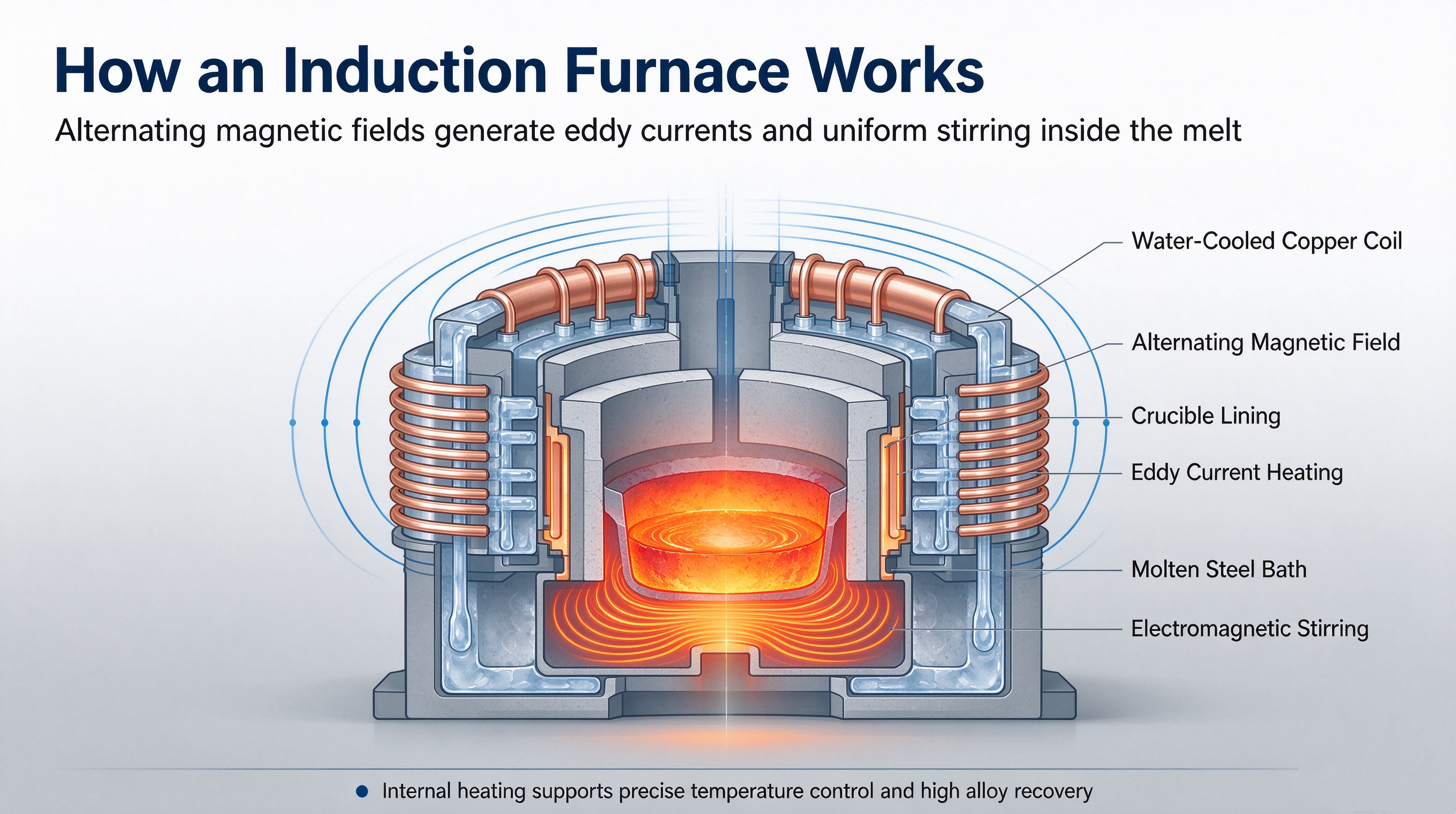
A distinct mechanical advantage of this process is the inherent electromagnetic stirring effect. The magnetic fields create a continuous rolling action within the molten bath. The frequency of the power supply dictates the intensity of this stirring; lower frequencies produce a more aggressive meniscus and deeper stirring action. This stirring ensures rapid temperature homogenization and uniform chemical composition throughout the melt, eliminating cold spots and stratification.
These characteristics define its primary use cases. The technology is highly favored in foundries, specialty alloy plants, and operations requiring frequent alloy changes in smaller batches. The precise control over temperature and chemistry makes it ideal for producing exact metallurgical specifications. Because the heat is generated internally within the metal, there is no localized superheating at the surface, which protects volatile alloying elements from flashing off.
EAFs accept a wide range of raw materials including low-grade, rusty and large bulky scrap such as HMS 1/2 and shredded auto scrap, thanks to the strong arc heat and large furnace top opening that supports bulk feeding and continuous preheating systems, bringing big cost savings on scrap purchasing. Induction furnaces require clean, dry and properly sized scrap; oversized pieces can jam above the melt zone and stop melting, while wet scrap may trigger dangerous steam explosions, so only clean cuttings and recycled foundry metal with known composition can be used. Both furnaces cannot remove copper or tin impurities, but EAFs can dilute these unwanted metals by adding high-purity DRI or HBI, which is not practical for induction furnaces due to waste impurities inside DRI.
The biggest difference between the two furnaces lies in metal refining. EAFs serve as refining reactors; operators create foamy slag by injecting carbon and oxygen to remove sulfur and phosphorus from molten steel, and this slag also protects furnace lining from arc radiation. Phosphorus removal happens early under oxidizing low-temperature conditions, while sulfur removal needs basic reducing slag and higher heat, usually finished in a subsequent ladle furnace. Induction furnaces only melt materials without chemical refining, so the final metal composition matches the input raw materials. Any slag formed is just melted rust and oxide waste that must be manually skimmed before pouring, and sulfur or phosphorus cannot be eliminated during melting.
EAFs suffer alloy losses from oxidation caused by open arcs and oxygen injection. Valuable elements such as chromium, manganese and silicon easily turn into oxides and enter slag, requiring extra ferroalloy additions to meet target chemical standards and raising material costs. Induction furnaces achieve over 95% recovery of reactive alloy elements. Without open arcs or oxygen blowing, oxidation is greatly reduced, and electromagnetic stirring quickly submerges alloy additives to avoid loss. Since no graphite electrodes are used, no extra carbon mixes into molten steel, making induction furnaces ideal for ultra-low carbon stainless steel, superalloys and aerospace materials demanding strict chemical control.
EAF systems require extremely high upfront investment and large plant space, needing heavy structural frameworks, 150-ton+ overhead cranes, complex exhaust treatment systems, large power transformers, and full closed-loop water cooling, plus costly deep foundation and slag pit construction. In contrast, induction furnaces feature far lower initial costs and a compact footprint, with simple foundation designs, small efficient solid-state power units, and standard cooling tower systems, making them affordable and easy to deploy for medium-sized foundries and new specialty steel projects.
EAF ongoing operating costs mainly come from continuous graphite electrode wear, large oxygen and carbon consumption, and frequent flux additions for slag formation. Induction furnaces eliminate electrode and most flux costs, but have shorter crucible refractory lifespans of only 100–300 heats. Their biggest long-term expense is premium clean, sized, high-purity scrap material, which costs more than the low-grade bulk scrap commonly used for EAF production.
Consumable / Metric | Electric Arc Furnace (EAF) | Induction Furnace |
|---|---|---|
Graphite Electrodes | 1.0 - 2.5 kg/ton | None |
Oxygen Consumption | 25 - 40 Nm³/ton | None (Atmospheric only) |
Refractory Life (Hearth/Crucible) | Long (Maintained via hot gunning) | Short (100 - 300 heats, full reline) |
Flux Additions (Lime/Dolime) | High (Active slag creation) | Minimal (Slag coagulants only) |
EAFs deliver superior high-volume output, handling 50–300+ tons per melt with fast 40–60 minute full cycles in modern high-power designs. Built for round-the-clock continuous production, they supply steady molten steel for continuous casting to make billets, blooms and slabs, and only shut down for planned maintenance. Induction furnaces focus on batch flexibility instead of large throughput; typical batches are 1–20 tons with 60–120 minute cycles. Their clean melting pot allows frequent, fast switches between steel grades from carbon steel to stainless steel without cross-contamination, which cannot be easily achieved in large EAF systems with heavy slag layers.
EAFs use hot repair methods: crews spray heat-resistant lining material onto worn furnace zones between melts while the furnace stays hot to maintain operation. Routine work includes adjusting electrodes, cleaning the furnace roof and checking water-cooled panels for leaks, and full hearth replacement is rare. Induction furnaces must fully stop production for complete cold relining. Workers remove the old lining, inspect copper coils, and install and cure new dry rammed lining material. Since relining stops melting, many plants adopt twin furnace setups: one pot runs production while the second undergoes lining replacement or holds molten metal to keep output uninterrupted.
EAF operations carry major safety risks, including water leakage-triggered steam explosions, intense radiant heat, high-voltage dangers, and flying slag, so modern plants use robotic tools for sampling, temperature testing and slag handling to keep workers away from hazardous areas. Differently, induction furnace hazards mainly come from wet or moisture-trapped scrap that causes violent explosions and refractory lining failure leading to molten metal leakage onto cooling coils. Safe operation depends on strict scrap inspection, preheating processes, and real-time ground leak detection systems to monitor lining integrity and cut power in advance.
EAF melting produces large amounts of particulate matter, toxic exhaust gases, and extremely high noise of 105–115 decibels during arcing, requiring full acoustic enclosures and high-power fume extraction systems to meet environmental regulations. In contrast, induction furnaces operate much cleaner and quieter, with steady noise levels of 80–85 decibels and far fewer dust emissions. Only minor local smoke and zinc oxide fumes may occur when melting galvanized, painted or oily scrap, which can be controlled with simple local exhaust hoods.
EAFs create unstable, erratic electric arcs that cause severe grid voltage flicker and harmonic distortion, requiring costly SVC or STATCOM power stabilization equipment to avoid disrupting local power supplies. Induction furnaces use solid-state IGBT and SCR power modules that produce predictable harmonic interference with almost no voltage flicker. Only basic harmonic filters and capacitor banks are needed for grid compliance, making their grid impact stable, controllable, and far easier and cheaper to manage.
To synthesize the technical and operational variables, facility planners must evaluate their specific production goals against the capabilities of each technology. The following framework categorizes the ideal deployment scenarios for each furnace type based on metallurgical demands and facility constraints.
Decision Criteria | Electric Arc Furnace (EAF) | Induction Furnace |
|---|---|---|
Primary Feedstock | Lower-grade, bulky, varied scrap; DRI/HBI | Clean, sized, known-composition premium scrap |
Metallurgical Goal | Active refining, dephosphorization, desulfurization | Dead melting, precise alloying, zero carbon pickup |
Production Scale | High volume (50-300+ tons/heat), continuous casting | Low to medium volume (1-20 tons/heat), batch flexibility |
Initial Investment | High CAPEX, massive infrastructure required | Lower CAPEX, compact facility footprint |
Target production exceeds 250,000 tons annually, requiring continuous, uninterrupted output to feed a rolling mill.
Local scrap markets offer abundant, cheap, lower-grade materials that require heavy processing and dilution.
The metallurgical process requires active dephosphorization and desulfurization to meet commercial carbon steel grades.
The facility design includes integration with Ladle Furnaces (LF) and continuous casting machines for high-volume billet, bloom, or slab production.
Target production is focused on high-value castings, specialty alloys, tool steels, or stainless steel where chemistry control is absolute.
Batch sizes are small, and production requires high flexibility with frequent, rapid grade changes without cross-contamination.
Capital constraints limit initial infrastructure investment, requiring a faster path to commissioning and a smaller physical footprint.
Strict limitations on noise, grid flicker, and particulate emissions exist at the facility location, preventing heavy industrial permitting for an arc furnace.
The process involves integration with Argon Oxygen Decarburization (AOD) vessels for duplex stainless steel refining, where the EAF vs induction furnace debate heavily favors induction for the initial clean melt before secondary refining.
The choice between an EAF and an induction furnace is not a matter of technological superiority, but of strict alignment with feed material availability, required metallurgical chemistry, safety infrastructure, and production scale. Selecting the wrong technology will fundamentally cripple a facility's operational efficiency and profitability. You must match the melting unit to the exact physical and chemical realities of your raw materials.
If your financial model relies on upgrading cheap, low-grade scrap into commercial-grade steel at high volumes, the EAF is mandatory. If your model relies on precision chemistry, high alloy yield, batch flexibility, and lower initial capital risk, the induction furnace is the optimal choice.
To advance your facility planning, execute the following next steps:
Conduct a localized scrap availability study to determine the exact grades, sizing, and pricing of raw materials in your region over a 5-year projection.
Model the regional electricity tariff structures, specifically analyzing peak versus off-peak rates and demand charges for high-megawatt loads.
Evaluate utility grid connection constraints with your local power provider to determine the necessity and cost of power quality mitigation equipment like STATCOMs.
Consult with an Engineering, Procurement, and Construction (EPC) firm to map out exact environmental permitting and safety compliance requirements before finalizing any equipment procurement.
A: No. Induction furnaces function strictly as melting units, often referred to as "dead melting." They lack the ability to perform active slag refining, meaning they cannot remove sulfur or phosphorus from the melt. The chemistry of the tapped metal depends entirely on the purity of the charged scrap.
A: Generally, an EAF consumes less electrical energy per ton of steel produced because it heavily utilizes chemical energy (oxygen lancing and carbon injection) to supplement the melting process. Induction furnaces rely entirely on electrical resistance for heating, resulting in higher specific electrical energy consumption.
A: While technically possible in small percentages, it is highly inefficient. DRI contains high levels of gangue (non-metallic impurities) and unreduced iron oxide. Because induction furnaces cannot run active slag practices to remove these impurities, melting high volumes of DRI causes excessive slag buildup and rapid refractory degradation.
A: EAFs utilize hot-patching, where operators spray refractory material onto worn areas between heats without cooling the furnace. Induction furnaces require the unit to be taken completely offline, cooled, and the entire crucible refractory rammed and sintered anew, which halts production for that specific vessel.
A: EAFs use consumable graphite electrodes to strike the arc. During the melting process, small amounts of carbon from these electrodes dissolve directly into the molten steel bath. This makes it exceedingly difficult to produce ultra-low carbon alloys, such as certain stainless steels, without secondary refining.
A: In an EAF, the most severe hazard is a leak in the water-cooled panels, which introduces water to the melt and causes a massive steam explosion. In induction melting, the primary hazard is charging wet or sealed scrap, which causes violent explosions, or a crucible run-out where metal breaches the lining and hits the cooling coils.