
Views: 0 Author: Site Editor Publish Time: 2026-08-17 Origin: Site


Surface and internal billet defects directly erode steel plant profitability, and the majority of these metallurgical failures originate after the mold, during the critical solidification phase. Plant managers and metallurgists must balance the need for high casting speeds and maximum casting machine output with the precise thermal management required to prevent corner binding, localized tension, and cracking. When a billet exits the mold, it possesses a fragile shell containing molten steel. If the subsequent cooling is uneven, the shell warps, cracks, or ruptures. Upgrading, converting, or optimizing continuous casting secondary cooling systems requires a rigorous evaluation of spray technologies, cooling strategies, and dynamic control software to ensure consistent heat transfer, structural integrity, and increased throughput. We must move away from static water application and implement dynamic, responsive thermal extraction to maintain production targets without sacrificing metallurgical quality.
Defect Prevention: Precise control over the secondary cooling section is the primary defense against transverse cracking, longitudinal cracking, and central segregation in cast billets.
Cooling Strategy Matters: Adopting advanced strategies, such as transverse non-uniform cooling, can significantly enhance heat transfer efficiency without increasing overall water consumption.
System Evaluation: Modernizing a cooling system requires evaluating nozzle technology (air-mist vs. hydraulic), dynamic control automation, water filtration capabilities, and the specific geometric requirements of the billet.
Implementation ROI: Upgrading secondary cooling infrastructure directly impacts the bottom line by reducing scrap rates, minimizing surface conditioning requirements, and enabling higher casting machine output.
Table of Contents
Establishing baseline requirements for the secondary cooling zone is essential for plant efficiency and product integrity. The primary objective involves maintaining a continuous, controlled solidification law. This process begins at the mold exit and extends down the entire metallurgical length of the machine. Operators must extract heat at a precise rate to thicken the solidified shell safely. Sudden temperature drops or spikes disrupt this delicate thermal equilibrium. Consistent thermal extraction ensures the liquid core solidifies uniformly, preventing internal stresses from tearing the fragile steel matrix apart.
Managing the thermal state inherited from the mold prevents catastrophic breakouts on the casting deck. The billet exits the primary copper mold possessing a thin, relatively weak solidified shell, typically only 10 to 20 millimeters thick. This shell contains a massive volume of liquid steel at temperatures exceeding 1500°C. The transition into the secondary zone demands seamless heat extraction continuity. If the initial spray zones apply excessive water, the shell shrinks too rapidly and cracks. If the sprays apply insufficient water, the shell weakens, bulges, and ruptures. Proper continuous casting secondary cooling bridges this gap safely, supporting the shell until it can withstand the ferrostatic pressure of the liquid core.
The system extracts sensible and latent heat through multiple physical mechanisms. Understanding these mechanisms allows metallurgists to tune the machine for specific steel grades. The primary modes of heat transfer include:
Radiation: Heat dissipates naturally from the glowing steel directly into the ambient environment of the casting chamber.
Conduction: Physical contact with support rollers and guide rolls pulls heat away from the billet surface mechanically.
Forced Convection: High-velocity water or air-mist sprays strip heat directly from the billet face, dominating the overall thermal extraction process.
Operators manipulate these forced convection rates to dictate the final output of the casting machine. Adjusting water flow and spray patterns alters the heat transfer coefficient dynamically. A direct correlation exists between the cooling curve and the final microstructure of the steel. The heat transfer rate determines the grain size and elemental distribution within the billet. Rapid cooling often promotes a finer grain structure but increases internal stress. Slower cooling reduces stress but can exacerbate segregation issues. Metallurgists carefully plot the ideal cooling curve for each specific steel grade, and the secondary cooling hardware must execute this curve flawlessly.
Binding at the corners of the billet within the mold creates significant vulnerabilities downstream. This binding interacts poorly with excessive or uneven secondary cooling on the billet face. When the shell binds in the mold, it experiences high frictional forces and uneven initial cooling. As it enters the secondary zone, subsequent uneven cooling causes localized thermal stress. The steel contracts unevenly across its width. This localized tension easily exceeds the high-temperature strength of the shell. Severe surface cracks propagate rapidly under these conditions. Operators must align mold taper and secondary spray distribution perfectly to mitigate this risk.
Over-cooling and subsequent reheating drive transverse and longitudinal cracking. When sprays apply too much water, the surface temperature plummets below the ductility trough of the specific steel grade. The surface contracts while the internal core remains hot and expanded. If the billet then enters a dry zone or a section with clogged nozzles, latent heat from the liquid core reheats the surface. This thermal cycling, known as recalescence, expands the previously contracted surface. The resulting push-pull effect destroys surface ductility. Longitudinal cracks form parallel to the casting direction, while transverse cracks form across the oscillation marks. Both defects require expensive surface conditioning or result in total scrap.
Aggressive secondary cooling causes the solidified shell to contract rapidly, acting like a rigid pipe. This rapid contraction compresses the liquid core initially. However, as the core eventually cools and shrinks, it pulls against the rigid outer shell. These internal stresses tear the mushy zone, which represents the fragile transition area between liquid and solid steel. Tears in this zone manifest as midway cracks. Furthermore, poor cooling distribution forces solute-rich liquid into these internal tears. This phenomenon creates severe center segregation, ruining the mechanical properties of the final rolled product.
Asymmetrical cooling in the secondary zone exacerbates uneven shell growth. Uneven growth often triggers initially within the mold due to poor lubrication, uneven water jacket flow, or physical misalignment. When the billet enters the secondary zone, uneven sprays worsen the condition. One face cools and contracts faster than the opposite face. This thermal imbalance physically distorts the billet cross-section. The square profile shifts into a diamond shape, a distortion known as rhomboidity. Severe rhomboidity causes jamming in the withdrawal rolls and complicates downstream rolling operations, often requiring the billet to be scrapped.
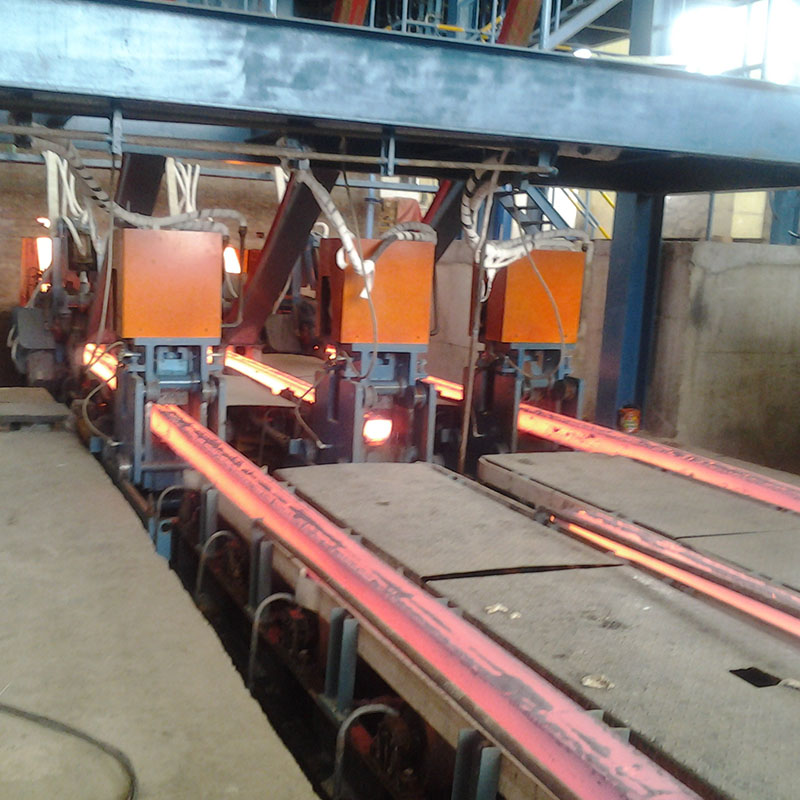
Square and rectangular billets present unique thermal management challenges. The corners experience two-dimensional heat transfer, meaning they lose heat from two adjacent faces simultaneously. This geometric reality makes corners highly susceptible to over-cooling. Over-cooled corners become brittle and crack during unbending operations at the bottom of the machine. Cooling strategies for square billets must actively reduce water volume near the edges. Operators utilize specialized spray headers to concentrate cooling water on the mid-face. This approach maintains a uniform transverse temperature profile across the flat surfaces, keeping the corners hot and ductile.
Round billets require entirely different secondary cooling strategies. The radial heat transfer dictates a uniform solidification law around the entire circumference. There are no corners to over-cool. However, maintaining perfectly concentric shell growth is critical. Uneven spray distribution around the radius causes the liquid core to shift off-center. This shifting leads to internal cracking and severe segregation on one side of the billet. Spray headers for round billets utilize overlapping full-cone nozzles. This configuration envelops the billet in a consistent, 360-degree cooling mist, ensuring the thermal center remains perfectly aligned with the physical center of the billet.
Hydraulic, or water-only, cooling systems remain common for smaller billet sizes and commercial-grade steels. They offer simple installation and lower initial equipment costs. Hydraulic nozzles rely entirely on water pressure to atomize the fluid. However, they suffer from significant limitations regarding turndown ratios. If operators reduce water pressure to lower the cooling rate for a slower casting speed, the spray pattern collapses. Droplet distribution becomes highly uneven, and the water stream can punch through the steam layer, causing localized cold spots. This limits the flexibility of the casting machine when producing different steel grades.
Air-mist cooling systems provide a much wider operating window. These systems mix compressed air and water inside the nozzle body or header. The compressed air atomizes the water into extremely fine droplets. This technology delivers softer, more uniform cooling across the billet surface. Air-mist systems maintain a stable spray pattern even at very low water flow rates. They drastically reduce thermal shocks and prevent the Leidenfrost effect from causing uneven heat transfer. Plant managers prefer air-mist technology for crack-sensitive steel grades, such as peritectic or micro-alloyed steels. The fine mist evaporates efficiently, maximizing heat transfer while minimizing water pooling on the machine structure.
Applying a flat, uniform water distribution across a square billet face creates inherent metallurgical problems. Uniform cooling ignores the two-dimensional heat loss occurring at the corners. Consequently, the corners over-cool rapidly while the center remains excessively hot. This thermal gradient generates massive internal and surface stresses. The rigid, cold corners resist the thermal contraction of the hotter mid-face. This resistance initiates longitudinal cracks and promotes rhomboidity. Uniform cooling strategies often force operators to lower overall machine speeds to prevent these defects, artificially capping plant output.
Transverse non-uniform cooling represents a significant technological shift in modern steelmaking. This strategy concentrates cooling water in the center of the billet face and intentionally reduces water volume at the corners. Evaluating this approach reveals major efficiency gains. It optimizes the cooling effect using the exact same total water volume. The non-uniform distribution mirrors the natural heat profile of the billet. It equalizes the surface temperature transversely. This equalization eliminates corner stress, reduces crack formation, and allows for higher overall casting speeds without compromising internal quality.
Comparison of Cooling Nozzle Technologies
Feature | Hydraulic (Water-Only) Nozzles | Air-Mist Nozzles |
|---|---|---|
Atomization Method | Water pressure only | Compressed air and water mixture |
Turndown Ratio | Low (spray pattern collapses at low pressure) | High (maintains pattern at low water flow) |
Droplet Size | Large, variable | Fine, highly uniform |
Cooling Intensity | Hard, prone to thermal shock | Soft, minimizes thermal stress |
Filtration Needs | Standard mesh filters | High-grade filtration required (e.g., 50-micron) |
Assessing nozzle types requires matching physical features to desired metallurgical outcomes. Flat fan nozzles deliver a high-impact, linear spray pattern. They suit the upper zones just below the mold where rapid heat extraction is necessary to build initial shell strength. Full cone nozzles provide a softer, circular footprint. They work well in the lower cooling zones to maintain shell temperature and prevent reheating. Engineers must evaluate spray angle, droplet size, and impact density. These variables directly dictate the heat transfer coefficient. Selecting the wrong nozzle geometry guarantees uneven solidification and subsequent billet defects.
Scalability and turndown ratio dictate the flexibility of the upgraded system. System conversions must accommodate varying casting speeds and diverse steel grades. The selected nozzles must maintain optimal spray patterns across wide pressure ranges. If a nozzle loses its spray angle at low pressure, it leaves sections of the billet uncooled, creating hot streaks. High turndown ratios allow operators to adjust cooling intensity without physically changing nozzles. This capability reduces downtime and increases the operational flexibility of the entire casting machine, allowing seamless transitions between different product orders.
Real-time thermal tracking software maximizes machine output safely. Static cooling models cannot account for sudden process variations, such as tundish temperature fluctuations or unexpected speed drops. Dynamic control systems adjust water flow continuously. They calculate requirements based on real-time casting speed, specific steel grade parameters, and tundish temperature. If the casting speed drops, the software immediately reduces water flow across all zones. This prevents over-cooling and surface cracking. Advanced algorithms predict the internal temperature profile of the billet slice by slice. This predictive capability ensures the metallurgical length remains within the designed machine boundaries.
Integration capabilities determine the success of a modernization project. The new secondary cooling automation must communicate flawlessly with existing plant infrastructure. It requires seamless integration with Level 1 programmable logic controllers (PLCs), which handle the physical valve movements and PID loops. It also must interface with Level 2 supervisory systems. The Level 2 system dictates the cooling recipes for different steel grades and tracks the billet through the machine. Poor integration leads to delayed valve responses and erratic water flow. Upgrades should utilize open-architecture software to facilitate smooth communication across all plant control networks.
Advanced nozzle technologies demand rigorous water treatment infrastructure. Air-mist nozzles feature internal mixing chambers and very fine orifices. They are highly susceptible to clogging from suspended solids, scale, and biological growth. Assessing filtration requirements is a mandatory step before any upgrade. Plants must install automatic self-cleaning strainers, typically rated for 50 microns or finer. They must monitor water hardness and chemical composition continuously. Frequent clogging destroys the spray pattern, leading to immediate billet defects. Investing in high-quality filtration guarantees the long-term reliability of the secondary cooling hardware.
Environmental and safety compliance shapes the final system design. Modern cooling systems must minimize overall water waste. Efficient spray distribution reduces the volume of water required per ton of steel cast. Furthermore, the system must manage steam extraction safely. Massive volumes of water flashing to steam create severe visibility hazards on the casting floor. Uncontrolled steam also causes severe corrosion on machine structures, sensors, and electrical conduits. Proper exhaust hoods and extraction fans must integrate into the secondary cooling zone. This ensures a safe, compliant, and visible working environment for operators while protecting the physical asset.
Risk: Nozzle Clogging and Maintenance Downtime. Dirty cooling water blocks nozzle orifices rapidly. A single clogged nozzle creates a hot longitudinal streak on the billet surface. This streak inevitably leads to cracking or a catastrophic breakout below the machine. Frequent manual cleaning causes unacceptable production delays.
Mitigation: Specify self-cleaning nozzle designs where possible. Upgrade the primary and secondary filtration systems to handle finer micron ratings. Implement strict predictive maintenance schedules. Utilize flow meters on individual header branches to detect pressure drops indicating partial clogs before they impact billet quality.
Risk: Misalignment and Uneven Cooling. Spray headers often suffer physical damage from cobbles or routine maintenance. Even a slight angular deviation alters the spray overlap. Poor overlap creates alternating bands of over-cooled and under-cooled steel. This thermal striping destroys the transverse temperature profile.
Mitigation: Utilize precision-engineered spray headers with rigid mounting brackets. Implement keyed nozzle tips that lock into the exact required angle automatically. Conduct regular alignment audits using specialized targeting lasers during scheduled maintenance outages. Ensure spray overlap remains mathematically accurate across all zones.
Risk: Retrofitting and Conversion Disruptions. Upgrading a secondary cooling system requires significant mechanical piping changes. Removing old headers and installing new air-mist infrastructure takes time. Extended installation periods cause costly plant turnarounds. Unexpected piping clashes delay restarts.
Mitigation: Partner with vendors who provide modular cooling headers. Demand comprehensive 3D laser scanning of the existing machine before design begins. Conduct extensive offline testing and pre-assembly of all valve stands. This preparation minimizes installation downtime and ensures a plug-and-play retrofit during the actual plant turnaround.
Conduct a comprehensive thermal audit of your current secondary cooling zone to identify heat transfer bottlenecks and uneven spray distributions.
Analyze historical defect data, specifically transverse and longitudinal cracks, to pinpoint cooling-related failures and correlate them to specific machine zones.
Request computational fluid dynamics (CFD) modeling from prospective equipment suppliers to validate proposed spray distributions before purchasing hardware.
Evaluate your current water filtration infrastructure to ensure compatibility with advanced air-mist nozzle technologies, upgrading to self-cleaning strainers if necessary.
Implement Level 2 dynamic cooling control software to automate water flow adjustments based on real-time casting speeds and steel grade recipes.
With experience in metallurgical engineering, equipment manufacturing, installation, and commissioning, WUXI LIWEI METALLURGY EQUIPMENT CO., LTD provides integrated solutions covering steel melting, continuous casting machines, and rolling mill projects.
Its combination of engineering design and practical project implementation provides a strong technical foundation for steel plants seeking to optimize continuous casting equipment, secondary cooling performance, and overall production efficiency.
A: The primary function is to control the solidification rate of the steel billet after it exits the mold. It extracts sensible and latent heat using water or air-mist sprays. This controlled cooling thickens the solid shell, supports the liquid core, and dictates the metallurgical length of the casting machine.
A: Cooling rates directly determine the internal microstructure and stress distribution. Uniform, controlled cooling prevents internal tears, center segregation, and surface cracking. Over-cooling causes brittleness and thermal stress, while under-cooling leads to bulging and potential breakouts. The cooling curve dictates the final mechanical properties of the steel.
A: Square billets experience two-dimensional heat loss at the corners, requiring non-uniform spray patterns to prevent corner over-cooling. Round billets require uniform, 360-degree radial cooling to maintain concentric shell growth and prevent the liquid core from shifting off-center.
A: Corner binding occurs when the billet shell sticks to the mold wall due to improper taper or poor lubrication. When this bound shell enters the secondary cooling zone, uneven water sprays cause localized thermal contraction. This contraction generates massive tension, tearing the weakened surface and causing severe cracks.
A: Transverse uniform cooling applies an equal amount of water across the entire billet face, often over-cooling the corners. Non-uniform cooling concentrates water in the center of the face and reduces it at the edges. This optimizes heat transfer and prevents corner cracking using the same total water volume.
A: Air-mist cooling mixes compressed air and water to create fine, uniform droplets. This provides a softer cooling effect, drastically reducing thermal shock. It also offers a wider operating window (high turndown ratio), allowing precise temperature control essential for crack-sensitive steel grades.
A: Dynamic control software adjusts water flow in real-time based on casting speed, steel grade, and temperature. This prevents over-cooling during speed drops and ensures adequate cooling during speed increases. It maintains optimal thermal profiles automatically, reducing scrap rates and allowing the machine to run at maximum safe speeds.


