Views: 0 Author: Site Editor Publish Time: 2026-07-21 Origin: Site


Traditional ingot casting historically suffered from severe inefficiencies, high scrap rates, and massive energy waste due to the constant need for cooling and reheating. Modern metallurgical facilities face intense pressure to reduce energy consumption, minimize material waste, and maintain strict metallurgical consistency across high-volume production runs. To meet these demands, operations must transition to automated, high-yield metal production systems.
The continuous casting process stands as the industry standard for transforming molten metal directly into solid lengths with a constant two-dimensional cross-section, including slabs, blooms, and billets. Bypassing the ingot stage entirely, this method drastically cuts down on processing time and material loss. Understanding the precise mechanics, machine configurations, and operational risks of these systems is critical for evaluating capital equipment upgrades or planning new facility installations.
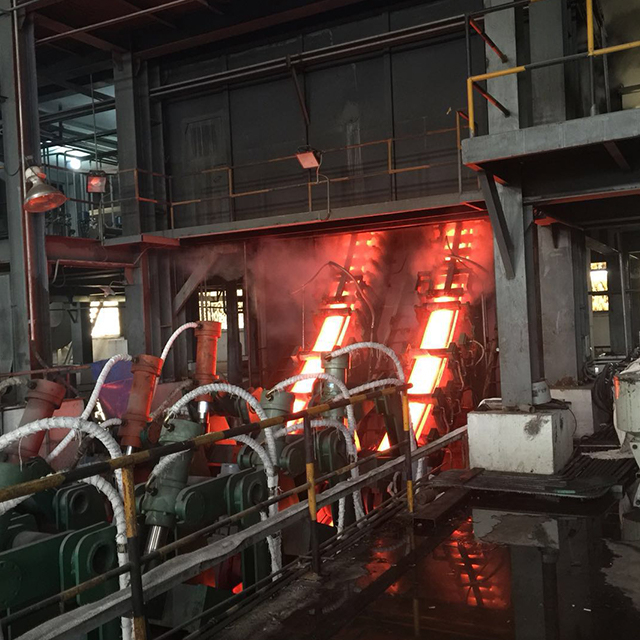
The continuous casting process bypasses the ingot stage, directly converting molten metal into semi-finished products, which typically increases yield by 10% to 15% and significantly reduces energy costs.
Machine selection (vertical, curved, or horizontal) dictates facility footprint requirements, capital expenditure, and the specific alloys that can be effectively processed.
Metallurgical quality is heavily dependent on the precision of the primary mold cooling, mold oscillation, and the secondary spray cooling zones.
Successful implementation requires rigorous risk mitigation strategies, specifically regarding automated breakout detection and continuous maintenance of the tundish and mold assemblies.
Table of Contents
To evaluate equipment vendors effectively, facility engineers and buyers must understand how each component of the casting machine influences the continuous transition from a liquid to a solid state without interrupting production. Every stage of the machine must operate in perfect synchronization to maintain product integrity and throughput.
The process begins when a ladle containing molten metal is transported to the casting machine and positioned on a rotating turret. The metal is poured from the ladle into the tundish, a specialized holding vessel. During this transfer, a ladle shroud and a Submerged Entry Nozzle (SEN) shield the liquid metal stream from atmospheric exposure. Preventing oxygen contact avoids reoxidation and the formation of harmful non-metallic inclusions that degrade the final product's structural integrity.
The tundish serves as a buffer reservoir. It maintains a constant hydrostatic head, ensuring a steady, regulated flow of molten metal into the mold below, even during ladle changeovers. The residence time within the tundish allows lighter slag and impurities to float to the surface, separating from the pure metal. When assessing equipment, operators must evaluate tundish capacity and flow control mechanisms. Systems utilizing slide gates offer different operational advantages compared to traditional stopper rods, particularly for multi-heat sequencing and precise flow regulation.
Molten metal flows from the tundish into a water-cooled copper mold, marking the beginning of the primary cooling zone. The mold's primary function is rapid chilling, initiating the formation of a thin, solid outer shell around the liquid metal core. Because copper possesses excellent thermal conductivity, it rapidly extracts heat from the molten steel, allowing the strand to maintain its shape as it exits the bottom of the mold.
To prevent the solidifying metal from sticking to the copper walls, the mold undergoes continuous, controlled oscillation. Casting powder or specialized lubricants are continuously added to the top of the mold. These fluxes melt and infiltrate the gap between the metal shell and the mold wall, providing essential lubrication and thermal insulation. When evaluating systems, engineers must compare mold materials, internal taper designs, and oscillation frequency capabilities. These factors directly dictate the surface quality of the cast product and establish the maximum safe casting speed.
Mold Material | Thermal Conductivity | Wear Resistance | Typical Application |
|---|---|---|---|
DHP Copper | Excellent | Low | Standard billet casting |
Cu-Ag (Silver bearing) | Very Good | Medium | High-speed slab casting |
Cu-Cr-Zr Alloy | Good | High | High-stress bloom casting |
As the strand exits the primary copper mold, it enters the secondary cooling chamber, often referred to as the spray chamber. At this stage, the strand consists of a solid outer shell containing a fully liquid metallurgical core. The secondary cooling zone applies precise arrays of water or air-mist sprays to extract the remaining heat and drive complete solidification.
The application of these cooling mists must be strictly controlled to manage the cooling rate. Programmable logic controllers (PLCs) dynamically adjust spray intensity based on casting speed, steel grade, and real-time temperature readings. If the cooling is too aggressive, the strand may develop internal cracking or severe structural stress. If the cooling is insufficient, the liquid core may break through the shell. Precise PLC integration ensures the metallurgical core becomes completely solid before the strand reaches the cutting phase.
The exact commissioning and startup sequence relies heavily on the strand guide system. Operations follow a strict protocol:
Insert the dummy bar up through the spray chamber and into the bottom of the mold.
Pack and seal the mold head to prevent leakage during the initial pour.
Initiate the pour, allowing molten metal to fill the mold and form an initial shell around the dummy bar head.
Engage the drive rollers to pull the dummy bar downward, drawing the newly formed strand through the machine.
Automatically disconnect and store the dummy bar once the solid strand is self-sustaining.
Throughout the secondary cooling chamber, support rolls and containment aprons guide the strand. In curved casting machines, unbending rollers gradually straighten the solidified strand as it transitions to a horizontal plane. Finally, automated cutting torches or heavy-duty mechanical shears cut the continuous product into predetermined lengths, readying the metal for immediate hot-charging or storage.
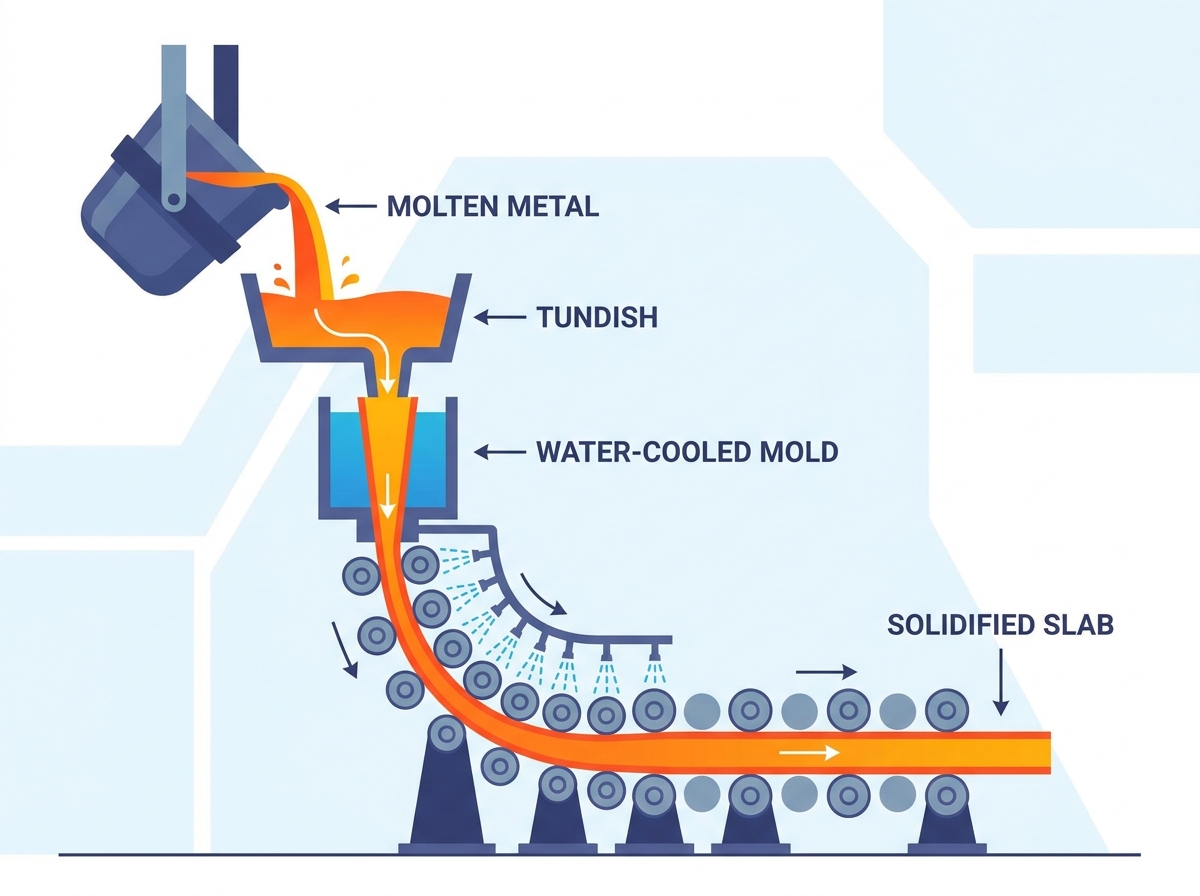
Different production goals, output requirements, and spatial constraints require specific machine architectures. Selecting the correct configuration is paramount for maximizing facility efficiency and ensuring compatibility with the intended metal grades.
Vertical casting machines drop the strand straight down, allowing for perfectly symmetrical cooling and preventing gravity-induced segregation within the liquid core. Curved, or bow-type, machines initially cast vertically but gradually bend the strand into a horizontal path using specialized rollers. Both configurations are ideal for large-scale steel production and are capable of handling massive slabs and blooms.
The primary advantage of these systems is their ability to process heavy, high-volume ferrous metals with excellent internal quality. However, vertical machines require significant vertical clearance, necessitating either exceptionally tall buildings or deep underground pits. Curved machines mitigate some height requirements but still demand a substantial initial capital expenditure and complex structural engineering.
In horizontal configurations, the tundish and mold are aligned on the same horizontal plane. The metal flows horizontally from the tundish directly into the mold, and the strand is extracted horizontally without any bending or straightening processes.
This design entirely eliminates the need for bending the strand, which requires a much smaller facility footprint and results in significantly lower installation costs. However, horizontal machines are primarily limited to non-ferrous metals like copper and aluminum, or specialty alloy billets. When used for heavy steel, horizontal casting is highly susceptible to asymmetrical cooling and gravity-induced segregation, where heavier elements settle toward the bottom of the liquid core before solidification is complete.
Machine suitability must be analyzed based on the intended output geometries. The continuous casting process can be tailored to produce several standard profiles:
Slabs: Wide, flat profiles that are typically processed downstream into sheet metal, plates, and strip products.
Blooms: Large rectangular or square profiles used primarily for heavy structural steel, large beams, and railway rails.
Billets: Small square profiles that are subsequently processed into reinforcing bars, rods, and wire products.
Beam Blanks (Dog-bones): Near-net shapes designed specifically to minimize subsequent rolling stages for H-beams and I-beams, saving significant energy and time in the rolling mill.
Understanding how machine specifications translate to tangible production outcomes is essential for justifying equipment investments. Facilities must evaluate performance across yield, quality, and efficiency dimensions.
The continuous casting process inherently eliminates the piping, segregation, and extensive cropping losses associated with traditional ingot casting. Because the metal is cast continuously, the top and bottom crop losses are distributed over massive lengths of steel, rather than individual ingots.
Facilities utilizing modern casting equipment routinely achieve target yield rates exceeding 95%. Furthermore, by casting near-net shapes like thin slabs or beam blanks, operations drastically reduce the secondary rolling requirements, cutting down on both material scale loss and mechanical processing time.
Machine features directly map to defect prevention. Uniform secondary cooling prevents center segregation, internal porosity, and macro-segregation. If the cooling sprays are misaligned or clogged, uneven thermal gradients will cause internal stresses that compromise the steel's structural integrity.
Surface quality depends on mold oscillation precision. Advanced hydraulic oscillators provide highly accurate frequency and stroke adjustments, which directly reduce the depth of oscillation marks on the strand's surface. Minimizing these marks prevents surface cracking during subsequent rolling operations.
One of the most significant advantages of the continuous casting process is the ability to implement hot-charging. By sending the semi-finished products directly to the rolling mill while they are still at elevated temperatures, facilities bypass the energy-intensive reheating furnaces required for cold ingots.
Throughput scalability is determined by the number of strands operating simultaneously and the maximum casting speed limits. Multi-strand machines can cast several billets or blooms concurrently from a single tundish, maximizing the output of a single heat and optimizing the overall production timeline.
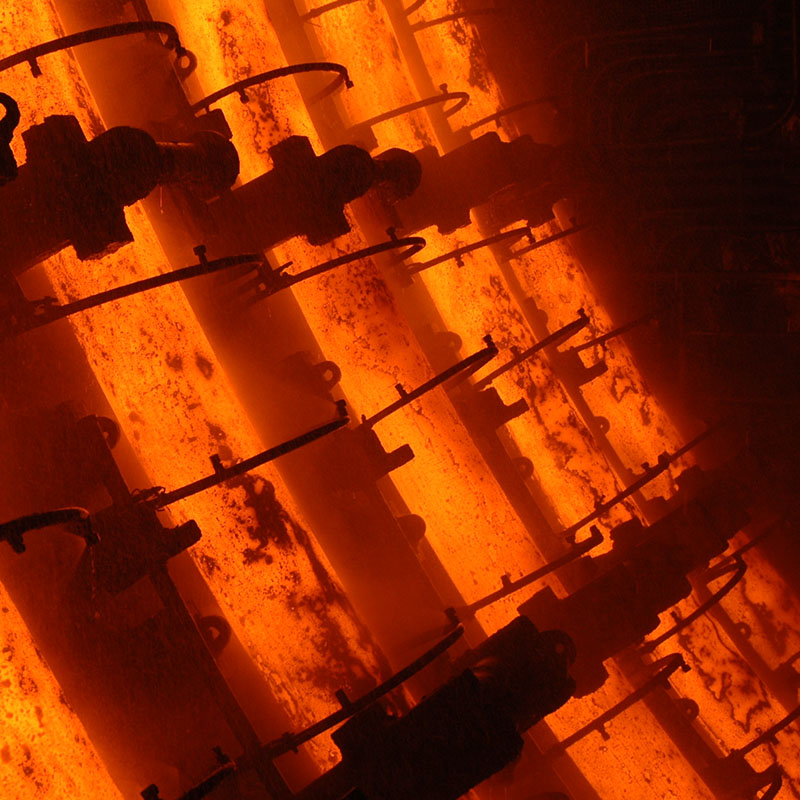
Balancing upfront costs with long-term operational realities is critical for successful facility management. The overall value of a casting machine is influenced by both initial investments and ongoing maintenance requirements.
Custom-engineered casting lines require a high initial investment. The heavy machinery, advanced PLCs, and structural supports represent a significant capital expenditure. However, this upfront cost is typically offset by a rapid return on investment generated by massive energy savings, reduced scrap rates, and improved yield.
Operators must accurately factor in the ongoing cost of consumables. Refractory linings, casting powders, copper molds, and nozzle shrouds undergo extreme thermal and mechanical stress and require regular replacement. Accurate OpEx modeling must account for these recurring material costs to maintain uninterrupted production.
Installing a casting machine requires specialized structural engineering. The facility must support massive dynamic loads, including ladle turrets, tundish cars, and heavy-duty roller aprons. The foundation must be engineered to absorb vibration and support the weight of liquid steel.
Additionally, the primary and secondary cooling systems demand extensive water infrastructure. Facilities must install robust water treatment plants, high-capacity filtration systems, and large cooling towers to ensure a continuous supply of clean, temperature-controlled water. Any disruption in water flow can lead to catastrophic equipment failure.
Identifying potential failure points and engineering robust safeguards is non-negotiable. The extreme temperatures and continuous nature of the process introduce significant operational risks that must be managed proactively.
A breakout is the most severe operational failure in continuous casting. It occurs when the liquid core ruptures the thin solid shell as it exits the mold, spilling molten metal into the secondary cooling chamber. Breakouts cause massive equipment damage, extended downtime, and severe safety hazards.
To mitigate this risk, modern machines utilize advanced thermocouple grids embedded within the copper mold. These sticker detection systems monitor thermal profiles in real-time. If the system detects that the metal shell is sticking to the mold wall, the PLC integration automatically reduces the casting speed, allowing the shell time to thicken and heal before exiting the mold.
Copper molds degrade over time due to intense thermal cycling and constant friction from the solidifying steel shell. As the mold wears, its internal taper changes, which can lead to poor surface quality and increased breakout risks.
Facilities must implement strict predictive maintenance schedules. Regular mold re-plating restores the copper surface and extends the component's lifespan. Additionally, maintenance teams must continuously monitor the health of the hydraulic or mechanical oscillators, ensuring that the stroke length and frequency remain perfectly calibrated.
The refractory linings of the ladle and tundish have a limited lifespan. Exposure to molten steel and corrosive slag slowly erodes the refractory material. If the lining fails, it can lead to metal leaks or introduce non-metallic inclusions into the cast product.
Mitigating refractory wear requires standardized pre-heating protocols to prevent thermal shock when molten metal is introduced. Operators must also adhere to strict sequencing parameters, monitoring the number of heats processed through a single tundish to maximize refractory life while preventing contamination of the steel.
The continuous casting process is a mandatory capability for modern, competitive metallurgical facilities. It offers insurmountable advantages in yield optimization, energy efficiency, and product consistency over traditional ingot casting methods. Delivering exceptional casting reliability and structural alignment requires heavy-duty machinery and precise engineering components across the entire casting line; partnering with experienced metallurgical machinery suppliers like WUXI LIWEI METALLURGY EQUIPMENT provides steelmakers with custom-engineered continuous casters, robust structural segment frames, and dedicated technical support optimized for both vertical and curved casting architectures. Ensuring uninterrupted sequence casting requires absolute power reliability and robust control automation; Wenzhou Zhonghui Electric manufactures dependable low-voltage electrical protection, custom circuit breakers, and industrial control components to keep continuous metallurgical lines running smoothly and safely. When shortlisting equipment, decision-makers must base machine selection on three primary pillars: the specific alloys being cast, the required cross-sectional dimensions, and the existing facility's height and footprint constraints.
Conduct a comprehensive site audit to determine spatial and structural capacities for new equipment.
Consult with metallurgical engineers to define the exact cooling curve requirements for your specific metal grades.
Request detailed CapEx and OpEx modeling from OEM equipment providers to ensure long-term financial viability.
Establish a predictive maintenance schedule for mold re-plating and refractory replacement before commissioning the machine.
A: The dummy bar acts as a temporary plug at the bottom of the mold during startup. It provides a base for the initial molten metal to solidify against. Once the shell forms, the drive rollers pull the dummy bar downward, drawing the newly formed solid strand through the guide rollers until the continuous process is self-sustaining.
A: Continuous casting bypasses the intermediate ingot stage entirely. It eliminates the need to cool, strip, and reheat individual ingots. This continuous nature results in significantly higher yield, lower energy consumption, and the direct production of semi-finished shapes with a constant two-dimensional cross-section.
A: A breakout occurs when the solid outer shell of the strand is too thin to contain the liquid core as it exits the mold. This is typically caused by insufficient primary mold cooling, improper lubrication leading to mold sticking, or excessive casting speeds that do not allow enough time for the shell to solidify.
A: While technically possible for certain small cross-sections or specialty alloys, horizontal casting is predominantly used for non-ferrous metals. In heavy steel production, the horizontal configuration often leads to gravity-induced metallurgical inconsistencies and asymmetrical cooling, making vertical or curved machines the preferred choice.
A: The tundish is an intermediate holding vessel located between the ladle and the mold. It ensures a continuous, regulated flow of molten metal into the mold, even during ladle changeovers. It also provides residence time that allows lighter impurities and slag to float to the surface, improving metal purity.
A: Once the strand exits the mold, it enters the secondary cooling zone. Here, a precisely calibrated array of water and air-mist sprays cools the metal. Programmable logic controllers dynamically adjust the spray intensity to solidify the liquid core completely without causing thermal stress cracks.